Thursday, July 25, 2013

Chickweed salve recipe

Here's a recipe for some Chickweed salve I made recently.


I have a friend who has one of the most amazing skin problems I've ever seen.  Whenever I see his hands I just want to cry it looks so painful.  Apparently it feels far worse than it looks, poor thing.

Over the years he tried almost every skin treatment imaginable, from fancy doctor stuff to holistic herbal whatcha things.  Most of them made the hurt and crack and bleed... but a few things worked for him and he gave me permission to make a salve based on that.

I have a theory that there are two main kind of skin problems - keep in mind, it's just an oversimplified theory based on my observation and questioning people I meet.  One kind of skin problem is caused by the immune system not working well enough, and the other is caused by the immune system working too well.  For people with the former, herbal lotions with calendula, honey, lavender, and other immune supporting elements will help, but for my friend, he needs the exact opposite.  It's like his immune system is attacking his skin in some sort of vengeful fit of rage at the world around it.


Chickweed in the past has helped my friend (let's call him Mr Kitten) so I thought I would start with that.  It has a nice soothing quality that doesn't encourage the immune system to take action.

I gathered up a large handful of fresh chickweed from the garden (it's a weed so I was 'gathering' it anyway), washed it well and chopped it medium fine.  Then I added it to lard and very gently simmered it in the slow cooker for two hours.

Cooking in the slowcooker was a mistake.  The temperature was way too high, so next time I'll cook in a double boiler situation.

When it smelt good and chickweed like, I strained the chickweed, added olive oil and beeswax to make the texture right (depending on where on the animal the fat came from, it may be too runny or too hard for a lotion).  Next time I won't be adding beeswax as I realize now it is one of those immune boosters.  Instead, I'll just use tallow fat which is much stiffer than regular lard.

Put it in jars, letting it cool before putting on the lid.

So far Mr Kitten says it's working well with a bit of a sting at the start.  I might try adding some Dock weed to the next concoction to see if that helps at all.

Wednesday, July 24, 2013

Sam gae tang - or Korean chicken soup

I found this nifty looking packet in a Korean grocery store the other day, and I just knew I needed to find out what it was for and cook it.


Okay, maybe it looks a bit messy here, but trust me on this one, it was delicious. The dish is something like a cross between pottage and chicken soup.  The soup itself is quite mild, with garlic, dates and chestnuts providing splashes of texture and taste sensations.  The kimchi (home made by the way) is necessary in my opinion.


In the packet is roughly 1 cup of sweet rice, one chunk of dry ginseng, 5 dates and 5 chestnuts.


Traditionally it is washed and mixed together and stuffed into gamecocks, put in a pot with water and cooked on the stove till done, adding more water as needed.

First I washed the package ingredients and put them to soak while I dealt with the chicken.

I didn't have a single serving chicken, so I used a regular size fryer.  I used the neck, wings, legs and breasts, in nice big chunks, bone in (the carcass became stock later on), put the pottage ingredients in the bottom of the pan with half a dozen cloves of garlic (peeled), lay the chicken bits on top, then added water to cover everything.  I brought to boil and then simmered on very low till it was done (stirring frequently).  Took about an hour and twenty minutes, but would make a nice slow cooker meal I think.

You can serve the chicken with the bone in, but I don't like to think too much while I'm eating, so I removed the chicken, skinned it (I left some of the skin on for flavour while cooking), shredded it with a fork, then placed it on top of the soup.

Tastes good, reheated the second day too.

Apparently this is a traditional summer meal in Korea and is good for keeping one cool during a heatwave.

Allergies: the ingredients were simple enough, no extra stuff like soy in this package.  Should be fine for most diets.

Affordable?:  Chicken is going up in price here the last five years or so, and the quality is going down.  The affordable chicken in the supermarket is repulsive to me, too fatty, too chemically, too much added water injected into the meat after it's been processed...  I use to eat two or three chicken a week, but now I maybe eat one or two a month, because the poultry I like, is a bit expensive.

To save money, instead of just buying chicken pieces, I bought a whole chicken and cut it up.  The link I just gave you is from the handsome boys at Sorted Foods.  It's the video that gave me the confidence to actually cut up a chicken.  I must have watched it at least 10 times before trying it on my own.

Note - did you know that when you cut up a cooked chicken, you don't carve it, you spoil (not unlace like I first wrote, that's what you do to rabbit) the chicken - English has so many beautiful and specific words that are dieing out, it makes me sad.

Locally a whole chicken costs a little under what two breasts cost in the store.   But with a whole chicken, I get the wings, the neck, the drumsticks, the thighs, the carcass and the breasts... With the price of poultry on the rise, I can no longer justify buying just chicken pieces.

After all that long rant, is it an affordable dish to cook?  $15 for a chicken, another four for the filling, another dollar for the kimchi as it was homemade, makes it $20 for the whole dish.  It made 8 bowls full of yummy, yummy soup that's not bad.  Roughly 2.50 per plate, but keep in mind, it is yummy and most people will want seconds and thirds.

Tuesday, June 25, 2013

Harvest and making random things

Time time of year my focus is more on outside the house than inside the kitchen.  The garden needs constant attention, the animals and...well everything.  But I still get a bit of time to cook what we harvest.

Calendula and sage for the dehydrator.  The sage is for tea and cooking, whereas I hope to have enough flowers by fall to make a dye bath for some fabric.  


Also in the photo are garlic scapes.  I never brought these into the kitchen before, so I really had no idea what to do with them.


I decided to try (a slightly altered) version of these cucumber pickles.  The ingredients are almost the same, but I used a different method for fermenting them.  Although it's going to be difficult improving on this already fantastic recipe, I plan to spend much of the summer attempting variations.


With a proper cellar I could see this being a great way to preserve cucumbers and other veg.  It was magical as the taste of the cumber went from salty to sour in just a few days.


I've also been harvesting several wild plants (aka weeds, of which we have many this year) for eating and medicinal use.  This is chickweed:


I used it to make a hand salve for a friend with some rather impressive skin troubles.  Chickweed has worked in the past for him, so I'm curious if my standard salve preparation would do the trick as well.

And finally, what would summer be without a pot of Kimchi on the go?

Daikon, carrots and su choi make up the bulk of this batch.  I chopped up some garlic scapes extra fine and tossed them in as well.  Very tasty.  Used the recipe from the book, Wild Fermentation - well more or less.

Tuesday, June 11, 2013

Vegetarian Vindaloo while camping


Having been camping twice now this summer, I have discovered that after being outside all day, even on a hot day, it is really nice to have a warm and wholesome dinner.


For the group I made vegetarian vindaloo with sourdough bread (both nettle and regular sourdough), home made wine sauerkraut and cucumber salad.  

The vindaloo included onions, carrots, tomatoes, potatoes, and chickpeas.  The cucumber salad - my personal favourite - was cucumbers, shallots, salt and white balsamic vinegar.  The most difficult aspect of this was to make something that everyone could eat - we had quite a collection of allergies in our group.

It worked out to be $3 per adult - which was a bit steep I admit.  However, I used organic veg, not all of which were in season, and when you factor the salads and the spice mix into the price, it adds up quickly.  

This time I made the curry (with help from The Captain) the day before heading camping, packed it in a big giant bucket, and then heated it up on site.  Next time, if I make it in advance like this, I will store it in two or three smaller buckets, and only heat up one at a time instead of the whole thing at once.  That way if people don't want it all, then it's easier to keep it for lunch the next day.

Saturday, June 1, 2013

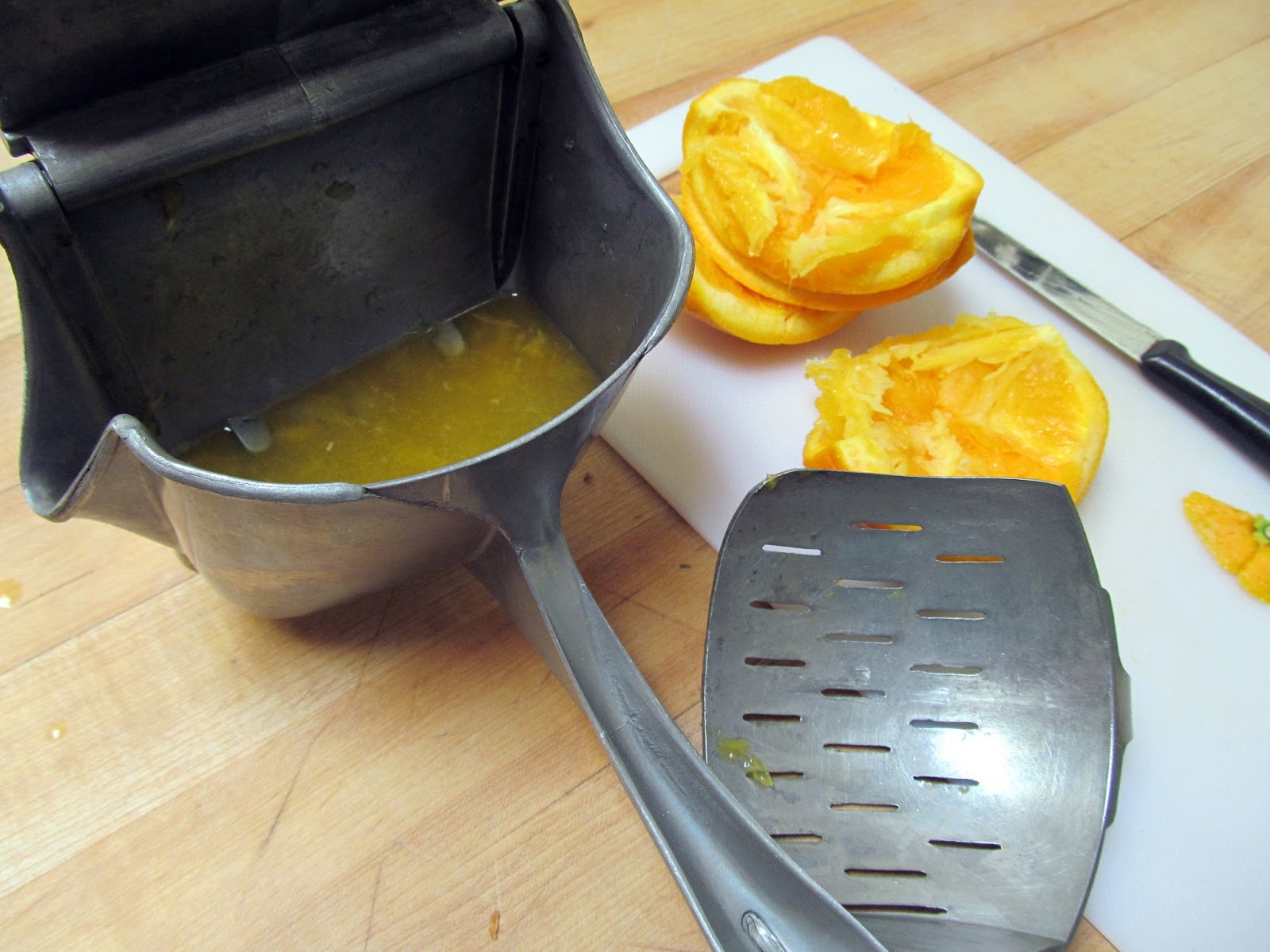
Vintage orange juicer

Actually, what more can I say?  It's a circa 1950s orange juicing device.  


It's also the most efficient orange juice I've ever used - and I've used a few in my day.  Very easy to squeeze and more importantly, it's super fast to clean.


first we slice the orange into quarters
place each quarter in the juicer and sqeeze

the juice is collected in a reservoir, as you can see when I remove the strainer
and there we go, one orange worth of juice.
Not much, I know, but it was really the wrong kind of orange for this.