Saturday, March 2, 2013

Lamb Sausages - kitchen failure? Almost.

My friend said it would be easy to make sausages.  Um, well, um, it turns out that easy is a relative term.


But what the heck, why not give it a shot.

He lent us his sausage maker and gave us some spices, which we mixed up with some already ground lamb we had in the freezer.  We soaked the lamb casings in water, and rinsed them really well.  

Next came the hard part, putting them on the stuffer tube.  The stuffer tube is just slightly larger than the casing, and the casings don't stretch much at all.  So with much struggle we managed to get the casings on the tube - minus a few rips here and there.  But hey, it's my first time.

While one person was struggling with the lamb casings, another mixed the meat and spices together.  Today was lamb and Mediterranean style spice mix.

Because I don't have a grinder yet, I'm working with pre-ground lamb.


As you can see, we made sausage:


Well, um sort of.

Lots of little breaks in the casings, stuffed it too full for the twisty thing to work.  But we put it in the fridge and fried it up for dinner the next day.


All in all, I'm up for trying sausage making again.  It's um... an interesting experience.

What I didn't like most was putting the casing onto the stuffer tube (going to try hog casings next time).  That and the sausages were actually too meaty.  Never had this problem before, but I think I have a solution for this.  Maybe try adding 20% bread (by weight) crumbs next time.

The things I liked best was how fresh it tastes and that I didn't need to worry about the ingredients and my allergies.

I can most definitely see a meat grinder (or two) in my future.

Thursday, February 28, 2013

Making Hot Smoked semi-candied Salmon at home: First attempt.

Having no recipe to guide me, working only from my own experience and fables of how they make that amazing smoked salmon in the northern part of Vancouver Island (Hardy Boys is one example you may have heard of), I decided to dive in and make smoked salmon.

My smoker, a mister to calm the fire, and home made maple syrup to brush on top


The first job was to cut up the salmon into long strips.


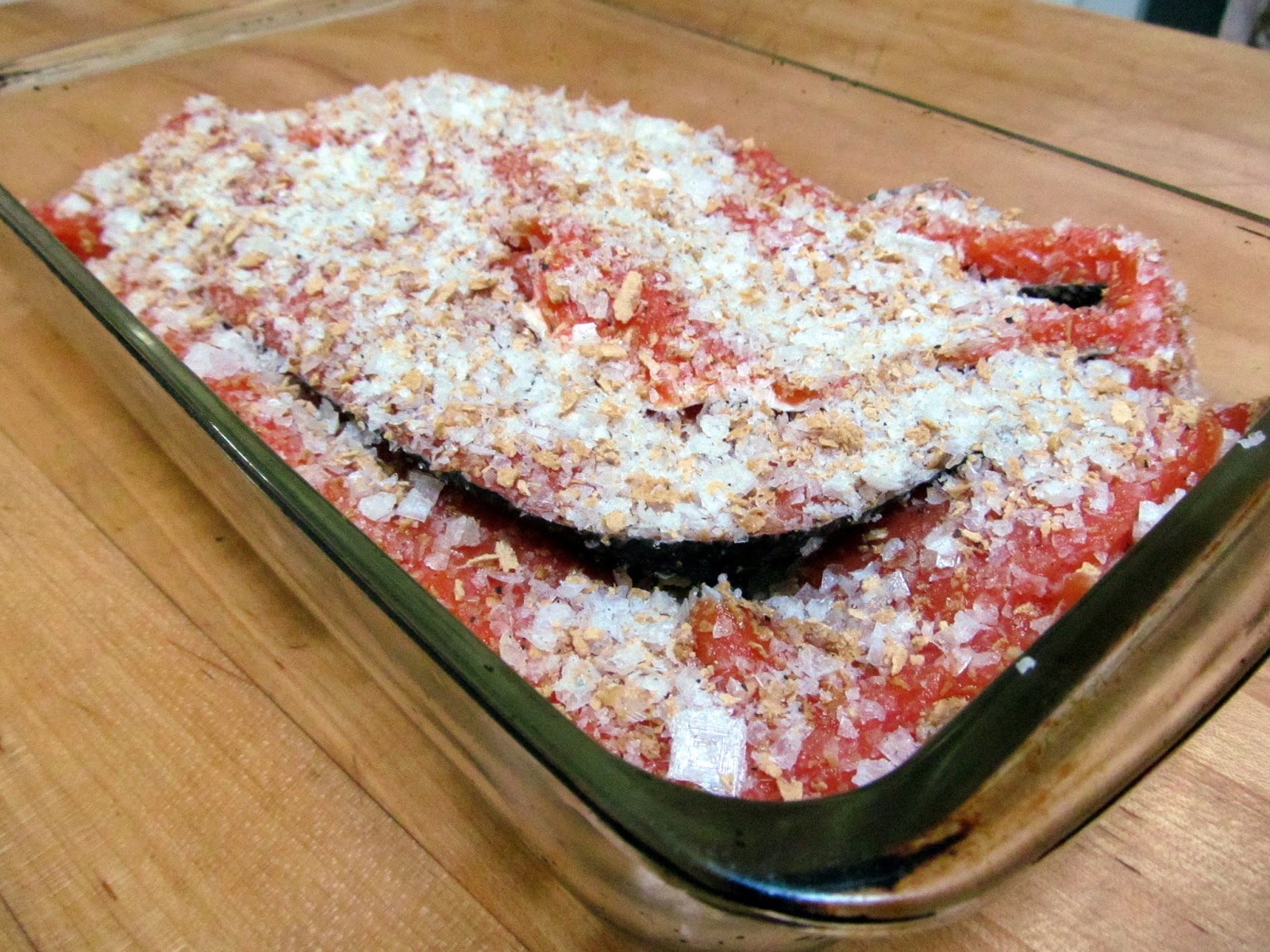
Then I made a mixture of salt, maple sugar, and black pepper.  I dredged each piece of salmon in the mix and cured it for about 20 hours.

Before
after curing
At this stage the salmon feels very firm.  All that moisture came from the fish.

I should have rinsed the salmon at this point, but I forgot.  Because of this, it turned out to be excessively salty.

I dried the salmon using paper towel, and left it on a rack, uncovered, in the fridge for about 2 hours to dry extra well.  From what I have read, this stage is super-important if you want the smoke flavour to stick.


This is a charcoal BBQ/smoker so I started it up about half an hour before I was ready to get smoking.  The fire is in a separate box attached to the side of the grill.  You build up a fire with charcoal and then you put the chips (in a tinfoil bag with holes in it) or blocks of wood on the fire to make some smoke.

The problem I encountered with this is that it got too hot too soon.  The fish actually cooked instead of slowly gathering smoke.  But not a complete loss.  Each time I use this smoker, I learn something new.


In the end, I only smoked it for about 2 hours.  Next time I think I'll smoke it for at least 4, maybe 8 hours.

But it looks good, and if you can get past the over-salty-ness of the whole thing, it actually has a lot of potential.


I wonder if I should add the label 'kitchen failure' to this post or not.  I mean, we ate the fish, and I learned a heck of a lot about smoking salmon.  But to be completely honest with you, it wasn't exactly the best smoked salmon in the world.  In fact, I would be ashamed to serve this to someone, even a friend.

But then again, I tried something new, without a recipe, and had fun making it.  I discovered new information about my smoker that I never realized before.  And about fish, and about curing in general.

Eventually, I'll get it right and post the final recipe here.

Wednesday, February 27, 2013

A special meal for a special day

I'm not big on holidays, unless they create a good excuse to cook up something special.  Today\s not an official holiday, but it is a special day for me.

I even made myself a present:


Okay, so it's not the most visually appealing meal in the world, but it sure is yummy!  I could have, and probably should have added some greens.

Duck Confit, apples stewed with rosemary in cider, and a quick and simple fettuccine with ham.  Of course a pint of cider goes really nice with the duck and the pasta.


It was extra delicious and a perfect treat for myself.

Friday, February 22, 2013

The lost 50 years of kitchen history, where did it all go?

There seems to be this huge gap of available knowledgeable from the turn of the last century to about 1954.  I spent hours searching for books or ephemeral from that time period with very little luck.

It all started when I wanted to learn about the icebox.  

I thought it would be a rather easy thing to learn about, but the internet is suspiciously mute when it comes to this subject.  Sure there are tutorials on how to put a block of ice in a non-functioning fridge, or how to use a camper cooler, but that's about it.  The wiki page has about the most useful info I've found so far, and this rather nice picture:

From the wiki page on iceboxes linked above


The icebox arrived as people moved to the cities from the country   Before the icebox, houses had cellars and larders, usually a room dug into the ground to keep food cool.  As population density in the cities increased, there was less and less room for cellars, but that's okay because there was always someone wiling to sell you something, and you could buy your food fresh daily.  Although buying food daily cost more than buying it when there was a surplus and keeping it in your home.  The idea of iceboxes sprung up, and were easy enough to make yourself or buy as your economic predicament dictated.  Having a place to store your perishables really helped save money and time.  

I've seen mentions of versions of the icebox pre-dating the Victorian period, but basically they took off during the middle of the 19th Century.  But the icebox has a rather short hayday.  It wasn't till the twentieth century that they really took off, and then as electricity moved across the nation, and houses were being wired into the grid, the icebox lost it's charm in favour of the electric refrigerator.  So, it seems that the rice and fall of the icebox corresponds to the same period of history that I'm having trouble finding information on.


You think about the time between 1900 and 1950.  There is a huge change in society in general, and this is reflected in the kitchen.  2 world wars, crop failures, Victory gardens, ration stamps, wide spread acceptance of industrialized agriculture, and industrialized pre-packaged foods. Go from the pantry to the icebox, to the electric ice box.  We moved from the country grocery store where you shop at least once a day and often had food delivered to your back door, to the once a week supermarket.  Microwaves were invented, a side effect of the atomic bomb I'm sure.  TV dinners.  Electric Freezers.  From wood, to coal, to gass, to electric stoves.  Mas transportation  highways, railroads, airplanes moving food not only across the country by around the world!  Perfection of canning techniques that no longer poison people with lead, and the creation of aluminium which allows lighter weight cans.  SPAM!  The fact that people were hungry enough to eat SPAM!  

Sure, we've had agricultural revolutions before that, and the major shift from rural to urban dwelling brought about by the 1800s, but I don't know of a time in history when so much changed in the way that people approached food.  It really surprises me that there aren't any books written on this topic.  At least I haven't found any.  I cornered the librarian and asked her to do a search, with no luck.  The next step for me is to brave the local archives and see if I can locate some ephemera from back then.  

Although I only started out wanting to know how people use to build and use an icebox, now I want to know more!  Project Gutenberg has a few wartime household manuals put out by the government (both US and UK) so I think I'll start there.  

Another place I'll start is asking old people about what life was like back in the day.  I bet there is a lot of good know how there that could be useful today, especially as a way to save energy in food storage.  

Taken at Fort Rod Hill park last summer.
A bit before the time in question, or maybe not,
electricity arrived quite late in many parts of North America.
I wonder how weird it would be if I went to the local old people home and asked 'hey, you got anyone old enough to remember what it was like to be a housewife pre 1950, but still with-it enough to tell me about it?' Probably be turned out on my arse, but it would be a bit of a lark to try.  Maybe I should put an add up on UsedAnywhere, "anyone got an old person who was a housewife pre 1950 who I can borrow for a few hours and listen to stories about how life was like back then?"  


It is my goal to build a working icebox, using old timey knowledge and modern materials.  I'm very curious about how efficient can we make it and what the temperatures are for different parts of the icebox.  Using an icebox requires a whole different mindset and approach to food safety which I'm curious to learn about.  


Anyone have any ephemera or household manuals, or experience with the kitchen between 1900 to 1950, please let me know know (to donate or for sale at a reasonable price - or even scan in to share with me?). Any good links or books you can recommend?  Just leave a comment here, I would love to hear from you.

Tuesday, February 19, 2013

The Quest for Bacon - Making Bacon at Home, Charcuterie Style.

My first attempt at making bacon at home turned out rather tasty.  It may not be the perfect rasher, but it is most certainly bacon.

Mmmmm, bacon.


I used the recipe from Charcuterie by Ruhlman and Polcyn for basic bacon.  I tried three different flavours, regular, pepper and maple.

You mix up a basic curing salt (sugar, salt, and pink salt) and coat the pork belly with the mix.  If you want a flavoured bacon, it's a good time to add the pepper or maple sugar.  Put the meat in a ziplock bag and keep it in the fridge for about a week.  Massage the juices that come out of the meat around the outside of the meat every day.  And that is how you cure the bacon.


cured bacon, read for smoking

Next you rinse it off, and if possible dry it for a few hours uncovered in the fridge.  Then pop it in the smoker.


I really wanted to use this smoker, an electric one that takes hardly any wood chips to make the smoke, but it's not working at the moment.  so, I got out the old BBQ smoker.


After about 3 hours, I still couldn't get the internal temp of the bacon to what the book said.  So I finished it off in the oven.


On the whole, I'm impressed with the fact that I made bacon.  It' tastes, um bacony.  It's over smoked and I cured it too long, so a bit salty.  But it is enough of a success to try again and soon.  

Price wise, it's a bit less than the normal bacon I buy from the speciality butcher, but more than commercial bacon (which I never buy).  The problem is I didn't get the pork belly on sale or at the right time of year.  So that's something I need to work on.  

The thing I like best about this is that I know exactly what went into making it.  Now, when the world comes to an end with the zombies or whatnots, I know I can survive, because I can make my own bacon.

I'm not going to write the recipe I used here because I followed almost to a T what's written in Charcuterie by Ruhlman and Polcyn .  But I plan to make more, and play around with some other recipes.  When I come up with one that's truly mine, then I'll be sure to share it with you.